
Complete Guide to Estimated Tax Payments for Small and Medium-Sized Auto Dealers: From Reducing the Burden to Financial Planning
What is Estimated Tax Payment?
Estimated tax payment is a system where you pay a portion of your income tax and special income tax for reconstruction in advance when your estimated tax base amount, calculated based on the previous year's income and tax amount, is 150,000 yen or more. This system aims to reduce the temporary tax burden during final tax returns and stabilize national revenue.
In the automobile sales industry, due to high vehicle unit prices and relatively high profit margins, even sole proprietors often become subject to estimated tax payments. For corporations, estimated tax payment obligations arise when the previous year's corporate tax amount exceeds 200,000 yen.
Who Must Pay Estimated Tax
In principle, those subject to estimated tax payment are individuals whose previous year's income tax amount (estimated tax base amount) exceeds 150,000 yen. In the automobile sales industry, particular attention is needed in the following situations:
- Sole proprietors with annual sales exceeding 10 million yen
- Used car sales dealing with high-value vehicles
- New car dealers generating stable revenue
Eligible individuals will receive a "Notice of Estimated Income Tax and Special Income Tax for Reconstruction Payment Amount" from the tax office in mid-June each year.
Tax Considerations Specific to Automobile Sales
The automobile sales industry has tax peculiarities that differ from general businesses. Particularly important is the handling of prorated automobile tax and compulsory automobile liability insurance premiums.
In used car transactions, prorated automobile tax and compulsory insurance premiums are treated as taxable transactions. This is because automobile tax is levied on the owner as of April 1st, and since the buyer has no tax obligation, the prorated amount paid by the buyer is considered part of the purchase price.
How to Calculate Estimated Tax Payment
Basic Calculation Formula
In principle, the estimated tax payment amount uses the previous year's income tax amount as the estimated tax base amount, and two-thirds of that becomes the annual estimated tax payment. Since this is paid in two installments, each payment is one-third of the estimated tax base amount.
Calculation example:
If the previous year's income tax amount was 300,000 yen:
- Estimated tax base amount: 300,000 yen
- Annual estimated tax payment: 300,000 yen × 2/3 = 200,000 yen
- First period payment: 100,000 yen (July)
- Second period payment: 100,000 yen (November)
Specific Example in Automobile Sales
Below is a calculation example for a sole proprietor operating a used car sales business9:
Business income: 8,000,000 yenSalary income: 0 yen (full-time business)Total income deductions: 1,200,000 yenWithholding tax amount: 200,000 yen
- Taxable income: 8,000,000 yen - 1,200,000 yen = 6,800,000 yen
- Income tax amount: 6,800,000 yen × 20% - 427,500 yen = 932,500 yen
- Special income tax for reconstruction: 932,500 yen × 2.1% = 19,583 yen
- Withholding tax amount (excluding special income tax for reconstruction): 200,000 yen ÷ 1.021 = 195,887 yen
- Estimated tax base amount: (932,500 yen + 19,583 yen - 195,887 yen) = 756,196 yen
In this case, estimated tax payments of 252,000 yen each (756,000 yen ÷ 3) are required for the first and second periods.
Payment Timing and Methods

Payment Schedule
Estimated tax payments are made twice a year.
First period: July 1 to July 31Second period: November 1 to November 30
In the automobile sales industry, July coincides with the summer bonus sales season and November with year-end sales preparations, so special attention to cash flow is required.
Types of Payment Methods
There are various methods for paying estimated taxes.
Direct Payment (e-Tax account transfer)
- No fees
- Complete online
Internet Banking
- No fees (bank fees separate)
- Available 24 hours
Transfer Tax Payment
- Automatic withdrawal
- No fees
Credit Card Payment
- Payment processing fees apply
- Points rewards available
Smartphone App Payment (300,000 yen or less)
- Payment apps like PayPay
- No fees
Convenience Store Payment (300,000 yen or less)
- QR code payment
- Available 24 hours
Utilizing Transfer Tax Payment
Since the automobile sales industry experiences significant seasonal sales fluctuations, we recommend using transfer tax payment. When using transfer tax payment, amounts are automatically withdrawn from your account on July 31 for the first period and November 30 for the second period.
Utilizing the Reduction Application System
Eligible Applicants for Reduction
Reduction applications for estimated tax payments are possible in the following situations:
- Income is clearly expected to decrease from the previous year due to poor business conditions
- In case of business closure, suspension, or unemployment
- Damage to business assets due to disaster, theft, or embezzlement
- Income deductions or tax credits are expected to increase from the previous year
In the automobile sales industry, reduction applications can be considered in the following situations:
- Sharp decline in sales due to COVID-19 or similar impacts
- Termination of contract with major supplier
- Temporary revenue deterioration due to store relocation or equipment investment
- Damage to inventory or equipment due to natural disaster
Application Procedures and Deadlines
Reduction application deadlines are as follows:
- First period reduction application: By July 15
- Second period reduction application: By November 15
Use the "Application for Reduction of Estimated Tax Payment Amount" form and submit it to your local tax office. Results of approval, partial approval, or rejection will be notified in writing or via e-Tax.
Late Payment Tax and Penalties
Late Payment Tax System
If estimated tax is not paid by the deadline, late payment tax will be imposed. The 2025 late payment tax rates are as follows:
- From day after due date up to 2 months: 2.4% per year
- After 2 months: 8.7% per year
Late Payment Tax Calculation Example
If 500,000 yen estimated tax payment is delayed by 30 days:
500,000 yen × 2.4% ÷ 365 days × 30 days = approximately 986 yen
While this amount is not particularly high, considering credit risks, payment by the deadline is important.
Special Tax Processing in Automobile Sales
Consumption Tax Handling
In the automobile sales industry, consumption tax processing can be complex. The following items require special attention:
Items treated as taxable transactions
- Vehicle body price
- Prorated automobile tax
- Prorated compulsory automobile liability insurance premium
- Inspection and registration processing fees
Items treated as tax-exempt transactions
- Recycling deposit
- Compulsory automobile liability insurance premium (when purchasing new car)
Items treated as non-taxable transactions
- Automobile tax
- Automobile weight tax
- Stamp fees
Inventory Management and Taxation
In used car sales, processing of automobile tax on inventory vehicles is also important. For vehicles held as inventory as of April 1st, the seller bears the automobile tax.
This automobile tax can be either included in the vehicle acquisition cost or recorded as taxes and public charges as an expense, but the principle of consistent application applies.
Cash Flow and Estimated Tax Measures
How to Create an Annual Financial Plan
In the automobile sales industry, it is important to understand the annual tax schedule including estimated tax payments in advance and incorporate it into your financial plan.

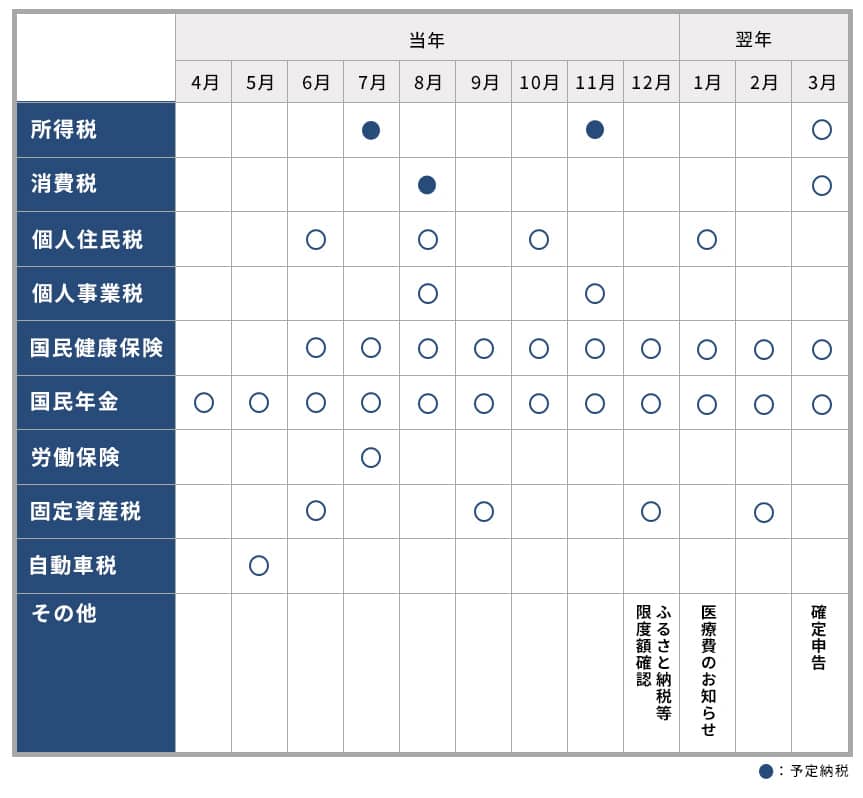
Major Tax Schedule
- March: Final tax return/settlement return
- May: Automobile tax
- July: First period estimated tax payment
- August: Interim consumption tax return (if applicable)
- November: Second period estimated tax payment
Utilizing a Tax-Dedicated Account
To prepare for estimated tax payments, we recommend opening a tax-dedicated account and regularly setting aside a certain percentage of sales. As a guideline, it's safe to reserve about 5-10% of sales as tax preparation funds.
Utilizing Small Business Mutual Aid
As a measure that combines business owner retirement fund preparation and tax savings, consider utilizing small business mutual aid. You can pay premiums up to 70,000 yen per month, and the full amount is deductible.
About Corporate Tax Estimated Payments
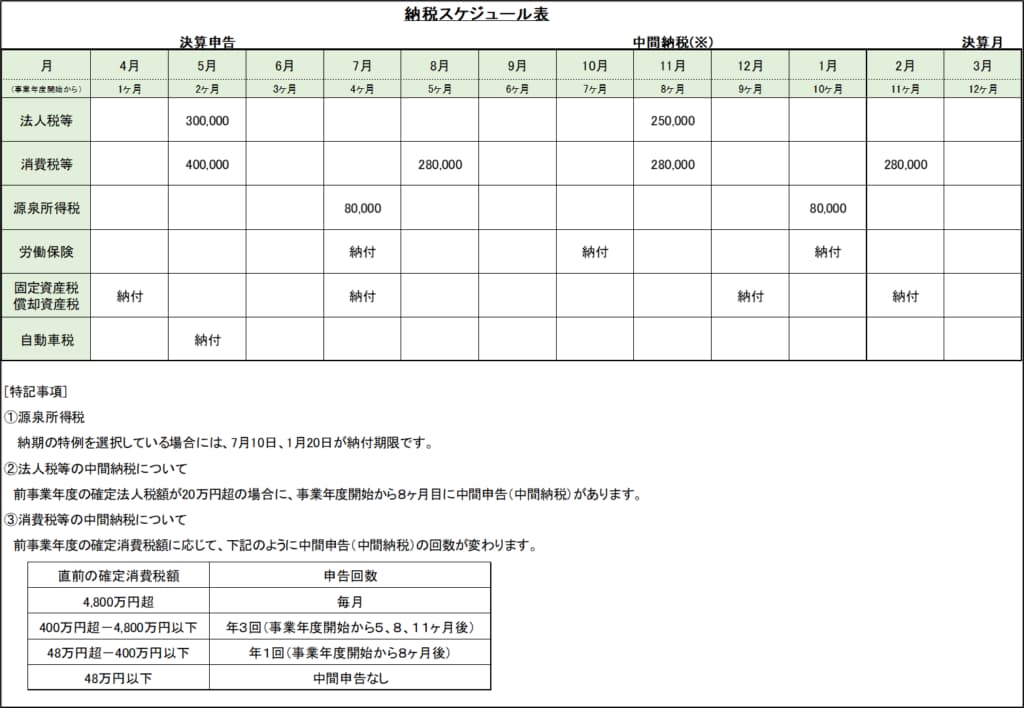
For corporations, estimated tax payment is required when the previous year's corporate tax amount exceeds 200,000 yen. Corporate tax estimated payments must be made within 2 months from 6 months after the start of the fiscal year.
How to Calculate Corporate Tax Estimated Payment
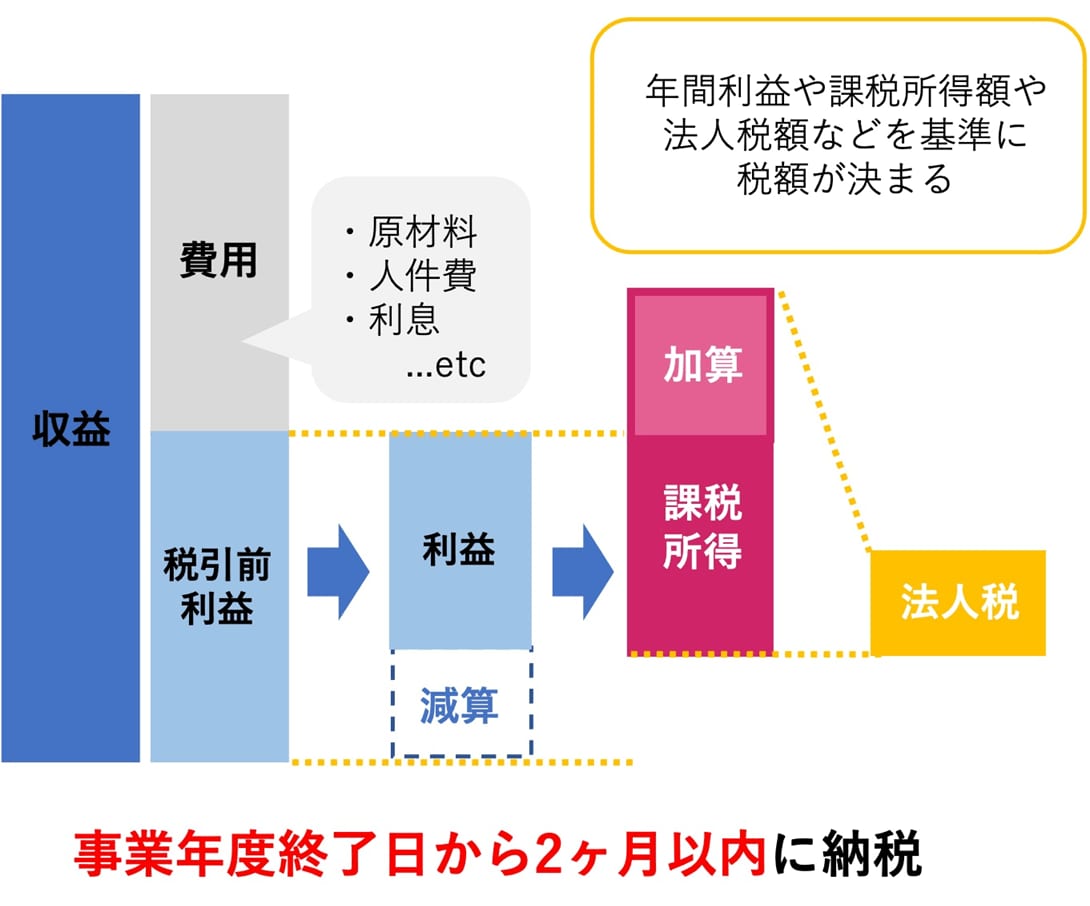
The corporate tax estimated payment amount is basically half of the previous year's corporate tax amount. For example, if the previous year's corporate tax amount was 1 million yen, the estimated payment would be 500,000 yen.
Choosing Between Estimated Return and Interim Settlement
For corporate tax estimated payments, you can choose between estimated return and interim settlement.
Estimated return: Simple calculation based on previous year's results
Interim settlement: Accurate calculation by actually conducting a 6-month settlement
Frequently Asked Questions and Answers
Q1: What if I don't receive an estimated tax notice?
A1: Tax payment obligations exist even if you don't receive a notice. Check your previous year's final tax return, and if your income tax amount exceeds 150,000 yen, contact the tax office.
Q2: What about estimated tax when incorporating?
A2: When incorporating from sole proprietorship, corporate estimated tax payment is required when the previous year's corporate tax amount exceeds 200,000 yen. It's a separate system from individual estimated tax.
Q3: What's the difference from consumption tax interim returns?
A3: Estimated tax payment is an income tax system and separate from consumption tax interim returns. Consumption tax interim returns are required when the previous year's consumption tax amount exceeds 480,000 yen.
Q4: What if my reduction application is rejected?
A4: Even if rejected, the difference from the actual tax amount will be settled during final tax return. If overpaid, you can receive a refund.
Summary
Estimated tax payment is an important tax system that small and medium-sized automobile sales businesses cannot avoid. With proper understanding and preparation, you can reduce the burden on cash flow and lead to stable business operations.
Particularly in the automobile sales industry, there are industry-specific considerations such as taxation treatment of prorated automobile tax and compulsory insurance premiums, and tax processing of inventory vehicles. Understanding these correctly and creating a financial plan based on year-round tax schedules is the key to success.
If you have any questions, we recommend consulting with a tax accountant knowledgeable about the automobile sales industry. Through proper tax management, let's aim for further business development.
Cartree lets you browse used cars for free and list your own.